Man of many talents

The phrase “man of many talents” seems to be expressing him. He is an architect, a writer, a boat designer, a boat maker, a captain, a sailing trainer, a master painter...
As you read these lines, he has already sailed away. When we asked him about the sea, “I cannot think of a life without stepping on the boat and sailing. A day gone without the sea is a waste for me.” he answered our question, with a manner of greeting the eternal blues out of the window of his study room... When we look into his eyes, we perceive that it is not possible to understand neither him nor the sea by just listening to his words. It cannot be helped to understand that, without falling in it, likewise falling in love.
A competent who is called “Sufi” of Sufism, which is often defined as "Islamic mysticism", says “Experience is significant not statements.” He talks about the things learned by experiencing, not listening. We understand that our share is to listen to a life, which is blessed with success and described with great humility and modesty, with admiration. The more we try to tell about Yucel Koyagasioglu, the head actor of a life dedicated to the sea, the less it will be missing…
Who is Yucel Koyagasioglu?
He was born in 1936 in Arnavutkoy, Istanbul. His childhood and youth were passed beside his uncle Nedim Özgen, one of the most famous sailors of that time, on the boat or in the shipyards. He completed his primary and secondary education in Galatasaray and his upper secondary education at Kabatas Boys’ High School. In 1958, he attended the examinations of the State Academy of Fine Arts with a sailboat model and passed them. Between 1965 and 1974 he worked as an architect in Sweden. When he returned home, he founded his own furniture atelier in Istanbul. In 1982 he began to make moulds for a 30-foot "sloop" with his son. By producing seven of those boats, he became one of the pioneers of producing the first serial GRP (Fibreglass Reinforced Plastic) boats in Turkey. In 1984, he started the restoration of the ketch boat of the Camper & Nicholson company called “Black Swan”, which would take 2 years. In 1986, he moved his atelier to Bodrum and manufactured various types of classical sailing and motor yachts, which he planned himself, ranging from 22 to 35 metres in length. He is the architect of the only training ship of Bodrum and Turkey, “STS Bodrum Training Ship”, which represented Turkey in several international races. He currently teaches Maritime Culture at Mugla University Maritime Faculty.
First of all, we would like to listen to your introduction to the Academy of Fine Arts
You are supposed to take some exams while enrolling in the academy, but they also want you to have something done to be able to measure your talent. A modern mosque project had been requested from me by the time I took the exams. They also want you to bring a model that you made. Therefore, I took the boat model that I made. The other children waiting there had messed around with me. I faced the jury, presented my model and we moved into a deep conversation about manufacturing boats. In this way, I joined the State Academy of Fine Arts in 1958 with my own ship model.
We know that you had worked as an architect in Sweden for about 9 years, then returned and set up a furniture atelier. How did you get back into the sea within this busy schedule?
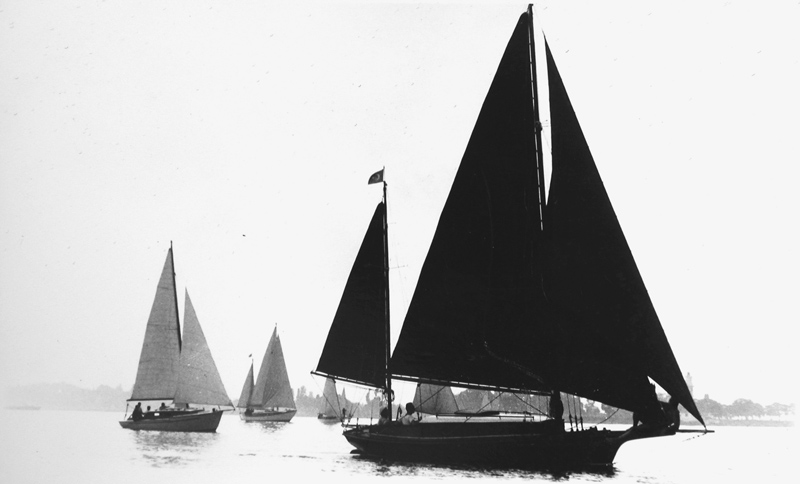
In 1982, I built the first polyester boat. It was a 30-foot (9.14 m) racer and a fly bridge boat. I still use the boat that I named “SEAWEED”. I manufactured seven of this boat and I became one of the pioneers of the first series of GRP boatbuilding in Turkey. Then, in 1984, I started to work on the restoration of the worldwide famous ketch boat, which took 2.5 years for me to finish, the Camper & Nicholson company boat called the “Black Swan.” At the full restoration in Büyükdere, I also made a pole of 40 metres for the boat.
Could you tell us about your arrival to Bodrum?
During the restoration of "Black Swan”, I got a job offer from Bodrum and in 1986 I moved my atelier to Bodrum with my team. After my arrival, first, I manufactured a square-sterned boat at the atelier on the way to Konacik. We had carried this boat from Konacık to Torba and launched it into the sea. After finishing this boat, I undertook the construction of five boats, which were started by the masters from the Black Sea, at the Sailors Shipyard in Icmeler. I took over the shipyard unfinished and then finished the boats. Finally, I launched and moored them to the dock.
We needed the mastery document to open our atelier in Bodrum. When I went to the Public Training Centre to get this certificate, I was asked if I had apprenticeship training and they told me they were not able to issue the certificate for an architect. According to my diploma, I graduated from “interior architecture” as written in my diploma. I sent a copy of my diploma to the governor Mrs. Lale Ataman. Finally, I got the certificate. However, it was prepared as a master chopper certificate. The reason was that there was not a certification called “Master of Boat Manufacturing” in Bodrum.
I worked for Durukos Yachting for a while. Meanwhile, we received an order for a square-sterned boat called "Queen of Peace" by a British nobleman. They have accepted the boat while consecrating by the priests. The priests had also consecrated my wife and me. I learned that it was a British tradition. Currently, that Boat is in Malta being chartered.
I manufactured the classic gulet called "ISTAR" upon an order coming from the world famous "Studio Faggioni" company located in the port of La Spezia in Italy.
I built Bodrum’s first classical motor yacht, which first named as "ERBEY", then "ALIZE" (trade wind in English).
The first time I came to Bodrum, there was a sense that the gulets could not go sailing. No, as a matter of fact, they are literally sailing boats. Such gullets have carried cargo between the ports in the Mediterranean for centuries by sailing only. Fortunately, Erman Aras started the Bodrum Cup races and these boats have improved their sailing characteristics since then.
Could you talk about the STS Bodrum, the first training ship of Bodrum and Turkey?
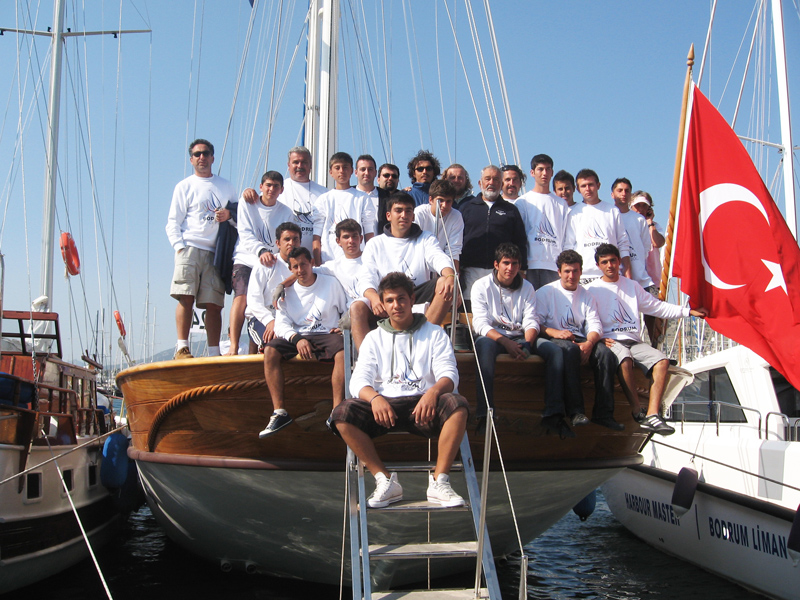
After I finished the production of "Durukos Jasmine" which is a gulet with Valena sailing style and schooner type three poles, when mooring it to the front of the Tepecik Mosque, I saw that a group of BOSAV – (abbreviation for Bodrum Karya Kultur, Sanat ve Tanıtım Vakfi - Karya Culture and Art Promotion Foundation in English) administrators including Mr. Erman Aras and Mr. Yucel Erkal were waiting for me on the shore. They stated that they were willing to have a training ship manufactured and asked me whether I could help them. I informed them that I approached this project very positively. In 15 days, I prepared all the manufacturing details of the ship and presented them. We completed the ship with the pieces of stuff and the money collected by voluntary work. Various pieces came from the navy and the artisans helped. We worked for two years in the shipbuilding but the fact that we had not had the source to be enough for the ship construction; therefore, it took more time to finish it. After finishing the ship, I claimed responsibility for training and became a trainer. We have gone to distant voyages. For about 15 years, we have attended the international school racing events and placed in them with a good ranking.
I would also like to mention the purpose of the manufacturing the STS Bodrum ship briefly. There were nearly 3000 gulets in Bodrum. There are minimum three men on a ship; the captain, the seaman and the cook. That means almost 10.000 people for the gullets. Besides, most boats are charters. The staff members must be trained and equipped. Most of the boats are trying to serve by employing the staff members they obtain from the villages around. Imagine that you are serving the tourists with untrained staff members, captains and even with children. We built the training ship with the purpose of training qualified personnel.
We shall talk about the rules of the sea now. Would you share the faults you observed on the boats with us?
On a sailing boat, you raise the flag of the country, to where you sail, at the fore; to down the crosstree on the starboard. This is a regulation that never changes. Unfortunately, some regulations are not followed on several catboats; sailing boats with a single mast placed well forward and carrying only one sail. You are not allowed to carry a bigger flag than your national flag, however, today the flags, which are larger than the national flag, of various sports clubs are being carried. While at the harbour, your national flag must be raised up to the flagpole on the stern side. If you are going to sail, the national flag must be raised up to the flagpole on the top of the mast, which is at the back.
The lights we call navigation lights are also used in the wrong place. These are surveillance by the Coast Guard Command and the Harbour Command. In the international conflict laws, it has definitively been stated when the navigation lights would be lit and where they would be located. We have made the training ship against all those mistakes. Many of the training participants say, "We must confess that we did not know these rules."
Let us talk a little about the books that you have conveyed your experiences with…
I was writing a number of articles for the magazines such as Sailing World and Naviga. They have accumulated over time. I have decided to collect my accumulations into a book with the support of Sadun Boro, deceased. My first book, "Istanbul Kotralari" (Istanbul cruisers in English), is about the stories of classical yachts of the Republican era, was published in 2007. My second book, "Sea Winged Fairies" was published in 2014. In the book, which contains basic information about sailing, I have described many ship types from "Ancient Ages" to "Giant Sailing Boats", from "Galiots" to "Galleons" including my own drawings.
Could you tell us about your photographic works?
I had a bellows camera. When I entered the academy, my late grandmother had bought me a camera. In those years, Gultekin Cizgen and I opened photograph exhibitions together. When I went to Sweden, I worked at a photo studio of an advertising company. I was using the Swedish brand Hasselblad camera. I started taking 360-degree photos with a simple technique of mine that I applied for the first time on this machine. It got too much attention. I applied for a patent and my application was accepted, however, I could not proceed, as the cost was too high for me. I was mentioned in some magazines as an inventor then.
Would you tell about ship model building?
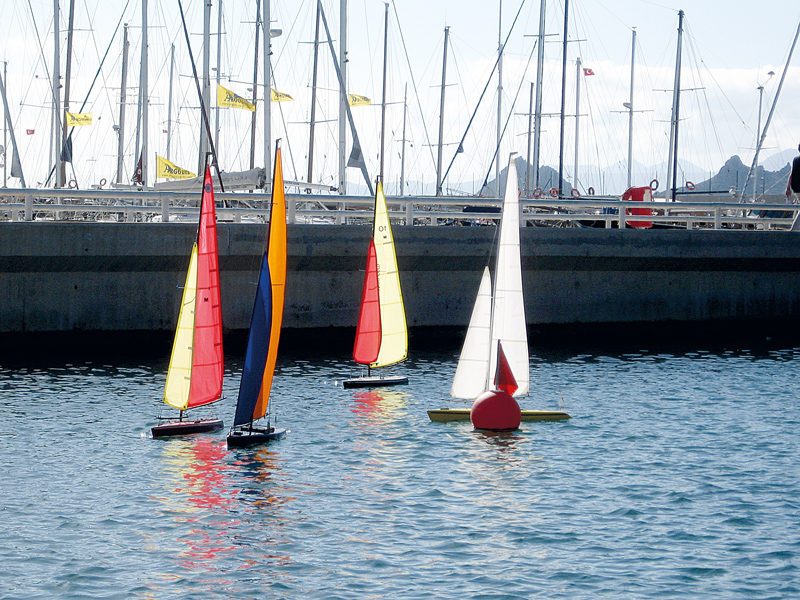
We raced model boats we made at Turgutreis Marina. There are two types of scale models of ships, we call “static” and “floating”. Floating models have mobility. It can be a sailboat or a motorised boat. They also have international races. Boats are made according to various classes and raced using remote controls. During my time in Sweden, I was a member of the Swedish Modellers Association.